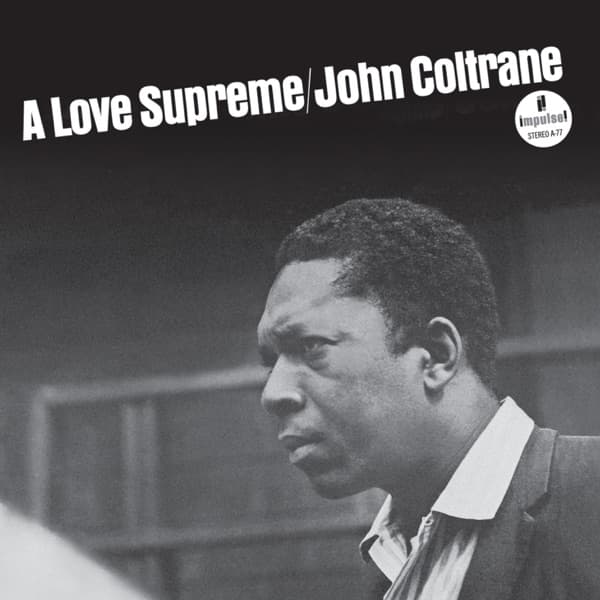

He won't look at you. On the front of A Love Supreme, John Coltrane is turned in profile, eyes lowered and fixed on something off the frame's edge, his brow drawn into a knot of concentration. The mood is interior, almost prayerful — a man caught mid-thought rather than posed for a camera.
The photograph is black-and-white, and the light does most of the storytelling. One side of Coltrane's face catches a soft glow; the other dissolves into shadow against a dim, blurred background that reads like a studio wall. He wears a dark jacket over a white open collar, the pale triangle of shirt the brightest note in the lower half of the image. Everything funnels the eye to that furrowed, downturned face.
The man behind the lens was Bob Thiele, who produced the album and also shot this cover photo — a closeness that shows in how unguarded the picture feels. The sleeve itself was designed by George Gray of Viceroy, who set crisp white type across the dark upper band: "A Love Supreme / John Coltrane," with the Impulse! Records logo and the catalogue marking "STEREO A-77" tucked to the right. The original LP carried this same image on front and back, identical on both sides.
What that contemplative face doesn't tell you is how fast the music came. The whole suite was recorded in a single session on December 9, 1964, at Rudy Van Gelder's studio in Englewood Cliffs, New Jersey. Coltrane conceived it as one through-composed work in four parts — "Acknowledgement," "Resolution," "Pursuance," and "Psalm" — with the murmured chant of "a love supreme" itself rising up inside "Acknowledgement."
He was so deliberate about that chant that the next day, December 10, he cut two alternate takes of "Acknowledgement" with tenor saxophonist Archie Shepp and a second bassist, Art Davis. Those versions dropped the chant — and Coltrane set them aside, preferring the quartet take where his own voice intones the title like a vow. The inside of the gatefold went further into devotion: his liner notes and psalm, laid out by Joe Lebow with an illustration by Victor Kalin, a separate piece of art from the cover photograph.
When Impulse! Records put it out in January 1965 as catalogue AS-77, nobody could have predicted the arc. Coltrane's albums usually moved around 30,000 copies; by 1970 this one had sold roughly half a million — and yet it never once appeared on the Billboard 200. It was nominated for the 1966 Grammy for Best Jazz Instrumental Album. Harvard's Ingrid Monson held it up as an exemplary recording of modal jazz, and it became a touchstone of spiritual jazz.
Its reputation only deepened. Robert Christgau called it "without question Coltrane's most beloved album" and noted it "cemented Trane's divine status in Japan." All of that weight rests, on the shelf, behind a single quiet photograph — no instruments, no fireworks, just a face half-lit and turned inward, looking like a man already listening to something the rest of us hadn't heard yet.