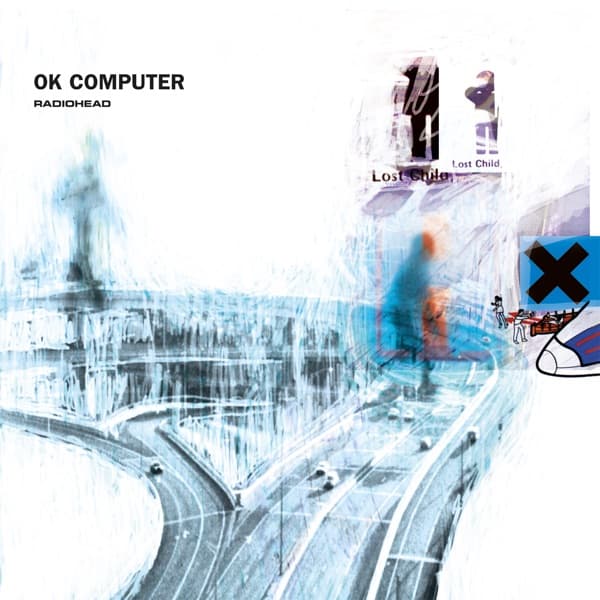
The image is built on a fall. Your eye drops from the top of the frame straight into the interchange, so that the composition reads vertically even though it depicts a flat road seen from above. The palette does much of the emotional work: Donwood described the blue-and-white scheme as an attempt to make something the colour of bleached bone, and the result is cold, drained, faintly clinical. Warmth has been leached out; what remains is a frosted, hospital-white light that makes the whole scene feel less inhabited than remembered.
Against that emptiness, the upper right is where the collage piles up thickest. A cluster of torn, pasted rectangles in bruised purples and greys carries the typed words 'Lost Child' twice over, like a misprinted notice photocopied into incoherence. The doubling matters: it turns a plain caption into a signal that has degraded, a warning that no longer quite communicates. Just below it sits a flat blue square stamped with a heavy black X, the universal pictogram for 'don't,' the kind you would find on an airplane safety card. Next to that X, tiny cartoon figures wave at a blue jet, the cheerful diagram of a safe evacuation rendered as something faintly absurd, a reassuring picture that reassures no one.
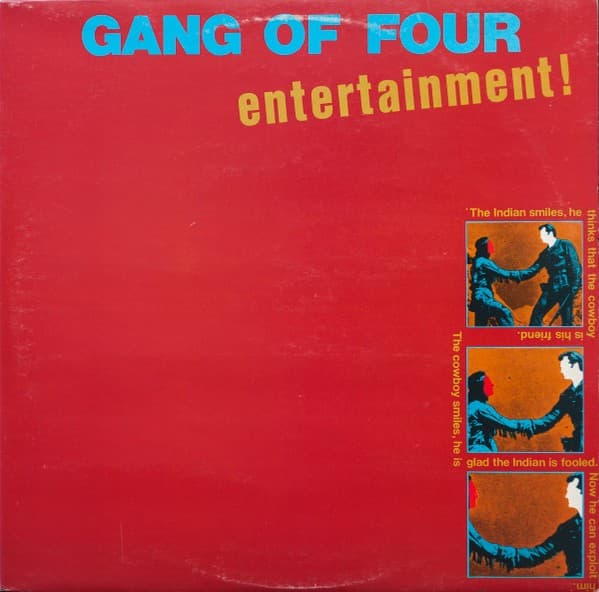
Two stick figures shaking hands recur through the package, on the liner notes and on the disc itself. Yorke explained them as a picture of exploitation: one figure being sold something they do not want, the other smiling and friendly only to close the sale. A handshake that is really a transaction. Compressed into a doodle, it is the album's anxiety about consumer life and dehumanised modernity made legible.
The surface everywhere shows its own history. Elements are overlaid, doubled, or violently scratched out in white rather than deleted, so the image carries visible corrections instead of hiding them. That refusal to tidy is part of the meaning: erasure here is loud, not invisible.
Against all this the typography is deliberately sober. In the top left corner sit two lines of plain black type, OK COMPUTER in capitals with RADIOHEAD smaller beneath it. No flourish, no logo, just label-like clarity floating on the white, letting the rest of the frame do the unsettling. The eye is anchored there and then released back into the chaos.
Read whole, the cover works because it holds two contradictory sensations at once: the god's-eye clarity of seeing an entire road system from above, and the total inability to find a way through it. The bleached motorway, the failed warnings, the transactional handshake and the absurd evacuation diagram all speak the same language of urban anxiety and information-age alienation. It looks like the inside of a mind that can see the whole interchange at once and still cannot find the exit.