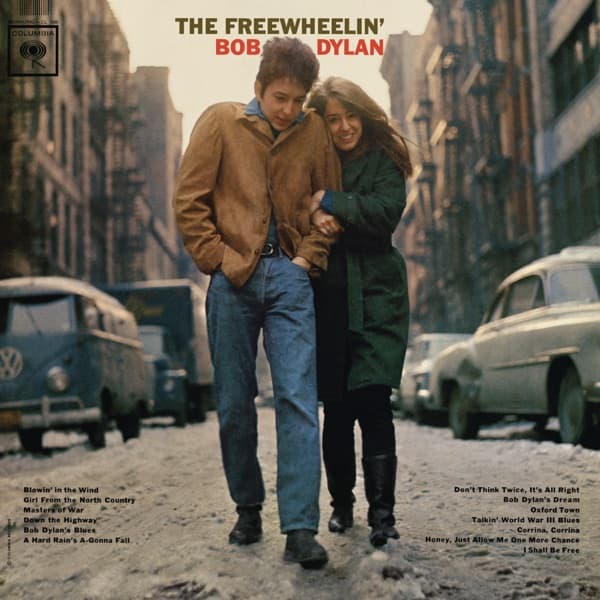
The composition works low and wide. The couple sit in the lower half of the frame, small against a long winter block, while the street seems to tilt up and open out behind them, drawing the eye deep into the perspective. The Village recedes in a wide, unglamorous view: parked cars lining both curbs, a Volkswagen van on the left, brick buildings closing in, the pavement wet and grey. Because the picture is shot low with a wide-angle lens, the street dominates and the figures become two specks of warmth in a cold, receding corridor.
Colour and tonality do the emotional work. The palette is muted, all greys and browns and the dull sheen of wet slush, so Rotolo's green coat becomes the one soft note of colour in the lower frame and Dylan's tan jacket the other. The overall chill of the image is not just weather; it is the tone of the whole thing, and the couple's closeness registers against that cold. What reads as tenderness is inseparable from two people leaning together to stay warm, and that ambiguity is exactly what gives the frame its charge: affection and endurance in the same gesture.
The eye travels from the two faces, held together at the center, back along the diagonal of the street to the far buildings, then returns to the pair. Nothing in the frame is arranged. There is no posing, no props, no set. The subjects are caught mid-stride rather than positioned, and that unguarded quality is the picture's entire argument: a musician presented not as a performer but as someone simply moving through his own neighborhood.
The typography sits lightly over the photograph. The title runs in green across the top, "BOB DYLAN" is stamped large in red, the Columbia logo tucks into the upper-left corner, and the song titles line the bottom corners in plain black. The red of the name against the grey street is the loudest visual event on the sleeve, but even that is restrained, letting the image breathe rather than crowding it. The design defers entirely to the photograph.
One detail rewards a second look: the woman so central to the image, clutching his arm and completing the picture's warmth, is unnamed anywhere on the cover. She is present as feeling and absent as identity, which quietly tilts the whole frame toward Dylan alone. Taken together, the low angle, the cold palette, the caught-mid-step spontaneity and the deferential type build a single meaning, that authenticity itself can be the subject, and that a picture can say more by looking like nothing was staged at all.