
Karl Ferris was a twenty-two-year-old fashion photographer who had never shot an album cover when Track Records hired him to create the artwork for the Jimi Hendrix Experience's 1967 debut. Ferris had been experimenting with infrared film and fisheye lenses in his fashion work, and these techniques, still novel in commercial photography, gave his images a hallucinatory quality that perfectly matched the psychedelic revolution Hendrix was leading. The cover photograph was shot in Kew Gardens, London, using a fisheye lens that distorted the three band members' faces into bulging, wide-eyed apparitions that seemed to peer out from another dimension.
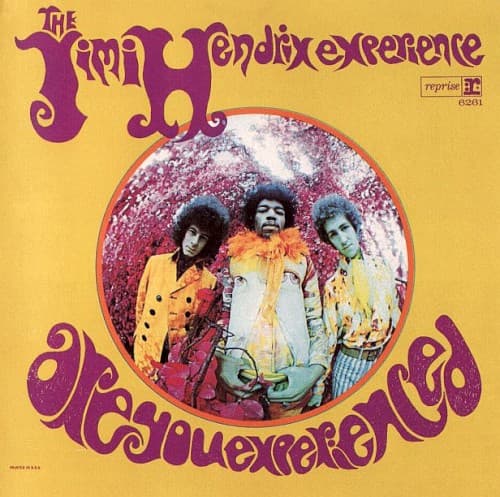
The fisheye distortion places Hendrix at the center of the frame with Noel Redding and Mitch Mitchell flanking him on either side, their faces stretched by the lens's extreme barrel distortion into shapes that are recognizably human but fundamentally altered. The effect is not grotesque but transcendent, as though the lens has captured what the subjects look like from inside a drug experience or a fever dream. Hendrix's face, being closest to the center of the lens, suffers the least distortion and commands the composition with the quiet intensity of his gaze.
Ferris used infrared film stock, which renders green foliage as white or bright magenta and skin tones as smooth, almost luminous surfaces. The resulting image is a landscape of impossible colors: the trees and gardens of Kew become a psychedelic wilderness of pink, red, and orange, while the sky shifts to deep blue or purple. This infrared palette was not added in post-production but is inherent in the film's chemistry, giving the colors a photographic authenticity that hand-tinted or filtered images lack. The viewer knows, on some level, that these colors exist in the emulsion itself, and this material reality gives the surrealism its uncanny power.
The composition is circular, dictated by the fisheye lens's characteristic vignetting, which frames the image in a dark border that fades to black at the corners. This circular framing creates a portal or peephole effect, as though the viewer is looking through a keyhole into an alternate reality. The three figures are arranged symmetrically within this circle, with Hendrix slightly elevated at center, creating a composition that echoes religious triptychs, the central figure flanked by acolytes or saints.
The color interactions between the infrared-altered foliage and the band members' clothing and skin create a chromatic richness that no conventional film stock could achieve. Hendrix's military-style jacket, already a vivid garment in real life, becomes even more intense in the infrared spectrum, its embroidery and braiding catching the transformed light in patterns that seem to pulse with energy. The overall palette, dominated by warm magentas, oranges, and purples against occasional cool blues, creates a visual experience that is both sensorily overwhelming and strangely harmonious.
The typography on the UK release features the album title in a psychedelic bubble font that was becoming the standard visual language of the counterculture in 1967. The lettering is organic and flowing, its curves echoing the distorted shapes in the photograph, and the colors of the text complement the infrared palette of the image. The integration of psychedelic typography with psychedelic photography creates a unified visual experience that communicates the album's content before the needle touches the record.
The US version of the album, released later in 1967 on Reprise Records, featured a completely different cover with a more conventional photograph and a purple-tinted palette. The disparity between the two versions highlights how radical Ferris's UK design was: the American label clearly felt it was too strange for the domestic market. History has vindicated the UK cover, which is now universally recognized as the definitive visual identity of the album and one of the key images of psychedelic culture.
Ferris's cover for Are You Experienced established the visual vocabulary of psychedelic rock photography: fisheye distortion, infrared color, and the transformation of ordinary landscapes into hallucinatory dreamscapes. Its influence extended through the late 1960s and into the visual culture of psychedelia's various revivals, from the neo-psychedelia of the 1980s to the contemporary interest in analog photographic processes. The image remains the definitive portrait of Hendrix at the height of his powers, a photograph that looks exactly like his music sounds.