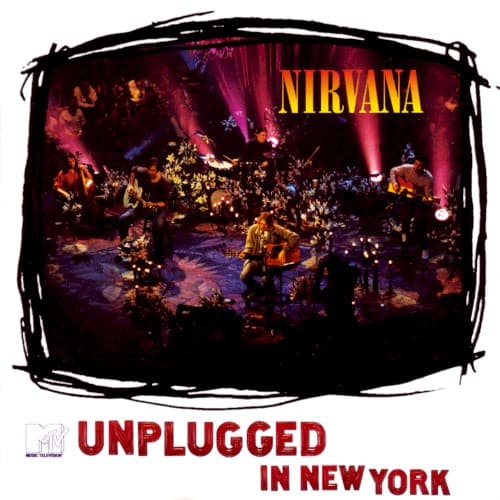

The first thing you notice is the warmth of the light, magenta and rose washing down from above, and then you realize what it's falling on: flowers everywhere, candles guttering on the stage floor, a crystal chandelier hovering over a band hunched into their instruments. It looks less like a rock set than a wake. That is exactly what it was meant to be.
The photograph that wraps MTV Unplugged in New York captures Nirvana mid-performance on a stage Kurt Cobain decorated himself. He asked for stargazer lilies, more flowers, black candles and heavy drapery. When producer Alex Coletti reviewed the requests and asked, 'You mean like a funeral?', Cobain replied, 'Exactly. Like a funeral.' On the cover you can see his vision realized: the seated figure at center cradling an acoustic guitar, lilies banked at the lip of the stage, the chandelier catching the pink stage lights.
The whole image is framed inside a rough, scratched black border, like a Polaroid edge gouged by hand, so the warm scene floats in darkness. Across the top, in tall yellow capitals, sits the single word NIRVANA. At the bottom, the MTV logo and the words 'UNPLUGGED IN NEW YORK' in bold yellow and white, the only hard graphic elements against an otherwise soft, smoky photograph. Robert Fisher handled the art direction and design, letting the funereal stage do the talking.
What the eye can't see is how nervous the man at the center was. Before the November 18, 1993 taping at Sony Music Studios, Cobain told MTV's Amy Finnerty, 'I'm scared,' and doubted whether the audience would even clap. He then proceeded to dismantle the entire premise of the show. Instead of leaning on hits like 'Smells Like Teen Spirit,' he stacked the set with cover songs and invited Cris and Curt Kirkwood of the Meat Puppets onstage for three numbers. Of the covers he chose, five touch on death.
Even the 'unplugged' part was a quiet rebellion. Cobain insisted on running his acoustic guitar through his amplifier and effects pedals, so Coletti built a fake box in front of the amp to disguise it as a monitor wedge. Drummer Dave Grohl, all power and force by nature, struggled to play softly, so Coletti handed him brushes and sizzle sticks wrapped, almost absurdly, in Christmas paper to soften the dynamics. The whole thing was taped in a single take.
It closed with Lead Belly's arrangement of 'Where Did You Sleep Last Night,' a performance often called the most haunting moment of the set, Cobain's voice fraying on the final lines. At the time it was simply a remarkable concert by a band at its peak.
Then, in April 1994, Cobain died. The album arrived on November 1, 1994 through DGC Records, copyright Geffen, roughly seven months after his suicide. Suddenly the staging he had described as a funeral read as a premonition. The lilies, the black candles, the drapery, the man sitting small amid them all in the rosy light: an image he had arranged as theater, now received as elegy. The eerie part is that nothing on the cover changed. Only what we knew did.