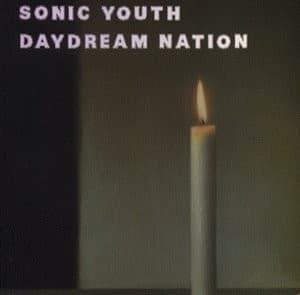
The cover of Daydream Nation hides one of art rock's best-kept secrets: that blurry, atmospheric image isn't an abstract photograph or custom artwork — it's a detail from Gerhard Richter's 1983 oil painting "Kerze" (Candle). The crop is so tight that the actual subject matter becomes nearly unrecognizable, transforming a representational painting into something that feels purely abstract.
The discovery happened by accident when Sonic Youth members were flipping through art books, searching for cover imagery that would match their sprawling double album's ambitious scope. Thurston Moore and Kim Gordon were immediately drawn to Richter's photorealistic yet dreamlike painting style, particularly this candle work that seemed to embody the hazy, introspective quality of their new material.
Rather than commission original artwork or stage an elaborate photo shoot, the band simply photocopied the image from the book. This lo-fi appropriation approach was entirely in keeping with Sonic Youth's aesthetic philosophy — taking high art and filtering it through punk sensibilities and DIY reproduction methods.
The original Richter painting shows a lit candle against a dark background, rendered in his signature style that blurs the line between photography and painting. By cropping so severely, focusing only on the flame and surrounding atmospheric glow, the band created something that felt entirely new while still carrying the weight of Richter's conceptual framework.
The appropriation was done without permission, a common practice in the pre-internet era when clearing rights was more complicated and expensive. Richter, known for his complex relationship with image reproduction and mechanical art-making processes, apparently never objected to the unauthorized use — perhaps appreciating the conceptual layer added by the band's recontextualization.
Enigma Records embraced the mysterious quality of the image, using it across various formats without explanation or context. The lack of text or band identification on many pressings made the cover even more enigmatic, forcing viewers to engage with the image on purely visual terms.
Critics and fans initially had no idea what they were looking at. Some theorized it was a photograph of fire, others suggested it might be an abstract painting or even a manipulated image of an explosion. The ambiguity became part of the album's mystique, perfectly matching the sprawling, impressionistic quality of the music inside.
The cover's influence on 1990s alternative rock artwork was substantial, inspiring countless bands to seek out similarly mysterious, cropped, and recontextualized imagery. The idea that a tiny detail from a larger work could become iconic in its own right opened new possibilities for album cover design.
Daydream Nation demonstrated how appropriation could be transformation — taking Richter's meditation on light and domestic intimacy and turning it into something that suggested urban decay, feedback, and sonic exploration. The same image carried completely different meanings in different contexts.
The cover has since been recognized as one of the most important album designs of the 1980s, frequently appearing on lists of greatest album covers. Its success lies in the perfect marriage of high art gravitas and punk irreverence — exactly the balance Sonic Youth struck in their music.
Decades later, Gerhard Richter's original "Kerze" painting sells for millions at auction, while vintage copies of Daydream Nation have become collector's items in their own right. The unauthorized appropriation created two separate but connected art objects, each enhancing the cultural value of the other.