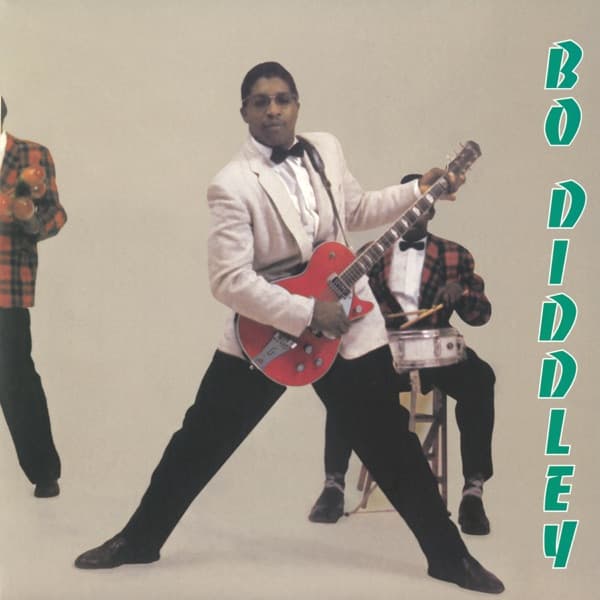
One of the most distinctive debut album covers in rock history almost didn't happen. When Chess Records decided to compile Bo Diddley's groundbreaking singles into his first LP in 1958, they knew the cover needed to match the revolutionary music inside.
Chuck Stewart was commissioned to photograph the cover, creating a portrait that would become iconic. The concept was straightforward yet powerful: capture Bo Diddley with his signature instrument, the rectangular Gretsch G6131T Jet guitar that had become synonymous with his sound.
The photo shoot was executed with striking simplicity. Stewart positioned Diddley against a plain backdrop, allowing the focus to fall entirely on the artist and his distinctive guitar. The composition emphasized Diddley's confident presence while showcasing the unusual rectangular body of his Gretsch, an instrument that perfectly matched his innovative musical approach.
Chuck Stewart brought his jazz photography expertise to the session, understanding how to capture the essence of musical innovators. His work on the Bo Diddley cover demonstrated the same intimate approach he used with other Chess Records artists, creating a sense of authenticity that matched the raw energy of the music.
While Don Bronstein was Chess Records' primary art director and photographer during this era, shooting over 500 album covers for the label, the Bo Diddley debut was handled by Stewart. This assignment came during a pivotal moment when Chess was establishing the visual identity of rock and roll.
The album received widespread critical acclaim upon release. Chess Records issued it as catalog number LP-1431, and it became a blueprint for how rock albums should sound. Critics immediately recognized the collection's significance in documenting the transition from blues to rock and roll.
The cover's visual impact was immediate and lasting. The stark portrait perfectly captured Diddley's revolutionary approach to music, with his rectangular guitar serving as a visual metaphor for his unique sound. The image became one of the most recognizable album covers of the late 1950s.
Stewart's photography emphasized Diddley's commanding presence through careful lighting and composition. The black and white portrait used dramatic shadows to create depth, while the clean background ensured nothing distracted from the subject. The typography was kept minimal, allowing the photograph to dominate the cover.
The album's cultural impact extended far beyond its initial release. Rolling Stone ranked it number 216 on their 500 Greatest Albums list in 2012, though it dropped to 455 in their 2020 update. The visual presentation helped establish how rock artists should be portrayed on album covers.
Stewart's cover photograph influenced countless rock album covers that followed. The simple yet powerful approach of showing an artist with their instrument became a template that labels used for decades. The image helped establish the iconography of rock and roll visual presentation.
Decades later, the album remains a touchstone for rock photography. Stewart's ability to capture Diddley's essence in a single frame demonstrated the power of thoughtful album cover design. The photograph continues to be referenced as an example of how visual art can perfectly complement musical innovation.
The Gretsch G6131T Jet guitar featured on the cover became almost as famous as the music itself. Diddley's rectangular instruments were custom-made by Gretsch starting in 1958, and the cover helped showcase this innovation to the world. The guitar's unique shape became forever associated with the Bo Diddley beat.