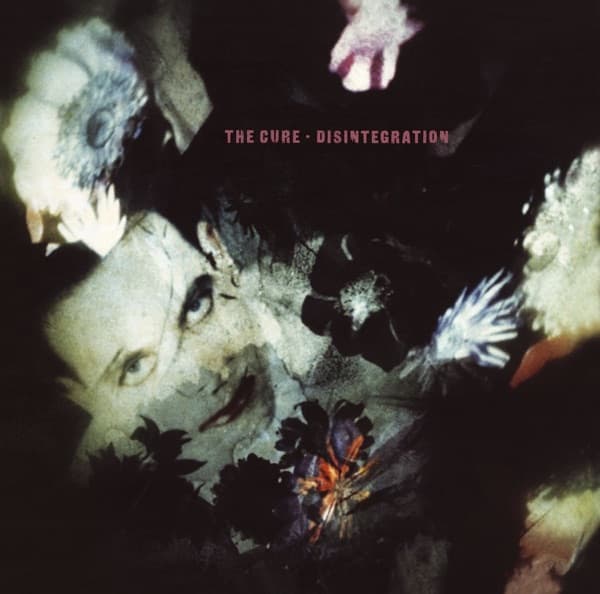

The first thing you notice is a face that doesn't want to be found. A pale forehead, one heavy-lidded eye gazing sideways, lips smeared into something between a smile and a wince, all of it floating up through layers of dark like a photograph developing underwater. Around it bloom flowers that seem lit from within, frost-blue and bruised purple, with a single hot streak of orange burning at the lower centre of the frame. Ghostly hands hover near the top edges, fingers spread. Nothing has a hard outline. Everything is going soft, going under.
That blur is the whole point. Disintegration, released by Fiction Records on 2 May 1989, took its sleeve from a process Andy Vella worked under the design name Parched Art, the partnership he shared with The Cure's own Porl Thompson. Vella didn't shoot a clean portrait and call it done. He built the image out of Polaroid transparencies, then projected them, overlaid them, and re-photographed the results, chasing what he described as a disintegration of colours and textures. He wanted the word read as something delicate coming apart, not as ruin or doom.
Look again and you can almost see the seams of that method. The face and the flowers don't sit in one plane; they bleed across each other, as if two or three exposures are competing for the same space. The blooms nearest the camera dissolve into pure smudge at the petal tips. The eye keeps sliding off the figure and back toward those luminous flowers, never allowed to settle, never given a focus to lock onto.
The man half-submerged in all of it is Robert Smith, though by Vella's account that was never the plan. He hadn't intended to put Smith on the cover at all. It simply felt right, he said, to have him almost seeping into the background rather than posed in front of it. So Smith arrives not as a frontman staring you down but as a presence being absorbed, a face the composition is in the act of swallowing.
Not everyone read the choice so generously. Keyboardist Roger O'Donnell reportedly grumbled that the cover got picked only because it had Robert Smith on it, a verdict Vella thought a bit unfair. You can hold both ideas at once looking at the sleeve: yes, that is the famous face, and yes, the face is the least sharply rendered thing in the frame, deliberately dissolved into petals and shadow.
The partnership that produced it started by chance. Porl Thompson met Vella on a train and asked him to photograph the band. When Smith saw the work, it was the out-of-focus shots he favoured, prizing the delicacy of images that refused to snap into clarity. That preference became a signature. Across The Cure's sleeves, Vella's hand shows up as dreamy, blurred, abstract imagery, and Disintegration is its fullest statement.
The typography keeps its distance from all that softness. Across the upper third, in slim pink-mauve capitals, sit the words THE CURE, a small dot, and DISINTEGRATION, neat and legible against the black. It's the only fixed point on the cover, the one thing not melting, and it floats in the empty dark above the face like a label pinned to a dream.
The music inside matched the surface. The album marked a return to the introspective gothic rock the band had drifted from, the kind of sound that gets filed under gothic rock and post-punk, all slow tides and reverb. The sleeve promises exactly that before a single note plays: a face going under, flowers glowing in the cold, and a word about coming apart, turned into something almost tender.