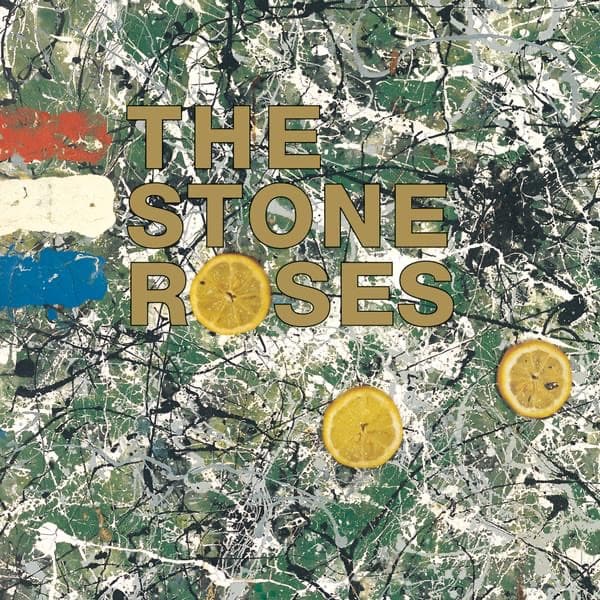

The first thing your eye fights through is chaos: a dense thicket of paint flung across the canvas in white, green, black and grey, threads crossing and pooling and dripping until the surface looks like ivy seen too close. This is no accident of design. It is a painting in tribute to Jackson Pollock, built with his drip technique, oil paint dribbled and flung rather than brushed. The man holding the canvas was not a hired artist. He was John Squire, the band's guitarist, who painted, designed and titled the whole thing himself.
Squire called the painting Bye Bye Badman, lifting the name straight from one of the songs inside. Both painting and song reach back to the May 1968 student riots in Paris, an event that happened two decades before The Stone Roses arrived on 2 May 1989 through Silvertone Records. Look to the top left corner and you find the reason coded into the image: a stack of red, white and blue blocks, the French tricolour, deliberately laid into the splatter as a flag of those riots.
Then there are the lemons. Three slices of real lemon sit flat against the painted surface, bright yellow wheels glowing against the cool greens and whites, each one casting a faint shadow as if genuinely pressed onto the canvas. One of them does double duty, becoming the letter 'O' in the word 'ROSES'. Squire described the device plainly: slice a lemon, use it as a graphic, then nail it to a painting.
Why lemons? The answer travelled home in the band's luggage. Ian Brown met a man while the singer was hitchhiking around Europe, a 65-year-old in Paris who had taken part in the 1968 unrest. He told them that sucking a lemon cancels out the effects of CS gas, that protesters used the fruit as an antidote to the tear gas police fired into the crowds. Squire took that story and turned it into the cover's central image, three bitter slices laid like trophies across the violence of the paint.
The typography keeps things simple and lets the surface breathe. The band name sits in tall, blocky gold capitals stacked over three lines, THE, STONE, ROSES, the warm metallic letters anchoring the eye against all that frantic motion behind them. The gold and the lemon yellow are the only true warmth on the cover; everything else is the painter's restless tangle of cooler tones.
There is a clever tension in all of it. Pollock's drip method is pure abstraction, action and chance with no subject, yet Squire bolted a precise political memory onto it: a flag, a fruit, a riot. The chaos of the paint reads almost like a street after the crowds have scattered, and the lemons become small acts of resistance pinned to the wreckage.
Slotted under Madchester, neo-psychedelia, indie rock and alternative rock, this debut announced a band who treated their sleeve as seriously as their sound. The cover does not picture the four musicians. Instead it shows you what their guitarist made with his hands, a painting that carries a stranger's war story from one century's barricades to the next generation's record racks. Three slices of lemon, nailed to a canvas, still telling you to suck on something bitter when the gas comes.