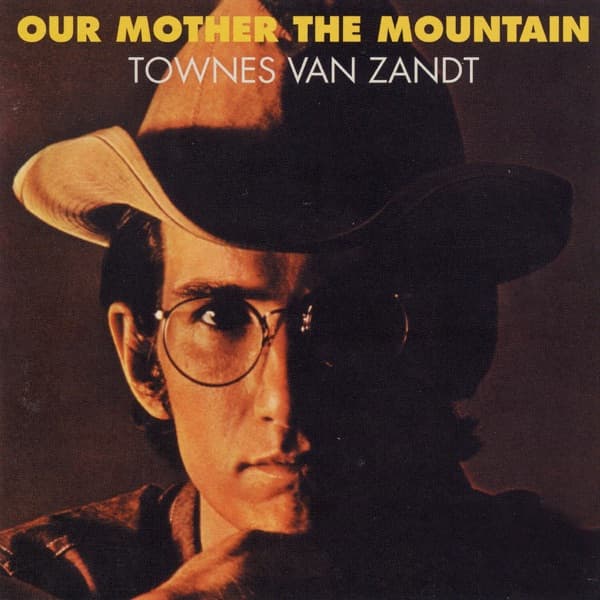
The first thing you meet is the eyes. Behind thin wire-rimmed glasses, Townes Van Zandt looks out from beneath the brim of a worn, floppy hat, and his gaze does not soften for the camera. One half of his face glows in warm amber light, the other half falls into deep brown shadow, the dividing line running straight down the bridge of his nose. The background is the same molten orange-brown as his skin, so the whole image feels lit by a single low lamp in a dark room. It is a portrait that refuses to flatter, and that was exactly the point.
When Our Mother the Mountain appeared in 1969, almost nobody knew who Van Zandt was. The album came out on Poppy Records, the small label run by Kevin Eggers, and selling an unknown name was the central problem. The graphic designer Milton Glaser solved it by not relying on the name at all. He explained years later, to John Kruth in 2007, that the cover was built to provoke curiosity, to make a browser stop and ask 'What the hell is that?' If the name couldn't pull a buyer across the floor of a record shop, the face would.
The photograph behind that strategy came from Allen Vogel, whose shot of Van Zandt does the heavy lifting. There is something arresting in how close it sits to the viewer, the brim cutting across the top of the frame, the shadowed jaw dissolving into the dark collar of his jacket below. Biographer John Kruth caught the intensity exactly when he later said that here Van Zandt's black eyes 'once glared so hard you might've wondered if he shattered the photographer's lens.' Compared to the gentler image on his next record, this is a man daring you to look away.
Across the top, the title runs in two heavy yellow lines that punch out against the dark hat. The lettering looks at first glance like Futura Extra Bold, that clean geometric sans everyone reaches for. It is actually Airport Black, a typeface from Baltotype dating to around 1943, a near-twin that resembles Futura so closely most eyes never catch the difference. The detail mattered enough that when Fat Possum reissued the album, the 2007 vinyl restored the original Airport Black while the CD and labels quietly swapped in Futura instead.
Beneath the bright yellow title sits the artist's name in cooler grey capitals, TOWNES VAN ZANDT, smaller and calmer, almost an afterthought against the shout above it. The hierarchy tells you everything about Glaser's gamble. The words that grab you are the strange, evocative title, not the unfamiliar name. You read 'Our Mother the Mountain' first and wonder what kind of person sings under a phrase like that, and only then do you learn whose face you have been staring into.
What makes the composition hold is its restraint. There is no scenery, no instrument, no props, just a head, a hat, and that knife-edge of light and shadow splitting the face into two moods at once: the lit half open and searching, the dark half guarded and unreadable. It mirrors, whether by design or accident, the doubled quality of the songs inside, a writer working in the folk and country-songwriter tradition who could sound tender and haunted in the same breath.
Decades on, this remains some of the most talked-about cover art in the catalog, reissued by Fat Possum in partnership with the Van Zandt estate, still credited to Glaser and Vogel. The irony lands cleanly. A cover designed because nobody knew the name now helps keep that name alive, the unblinking eyes still doing the work they were hired to do: stopping you, holding you, making you ask what the hell that is.