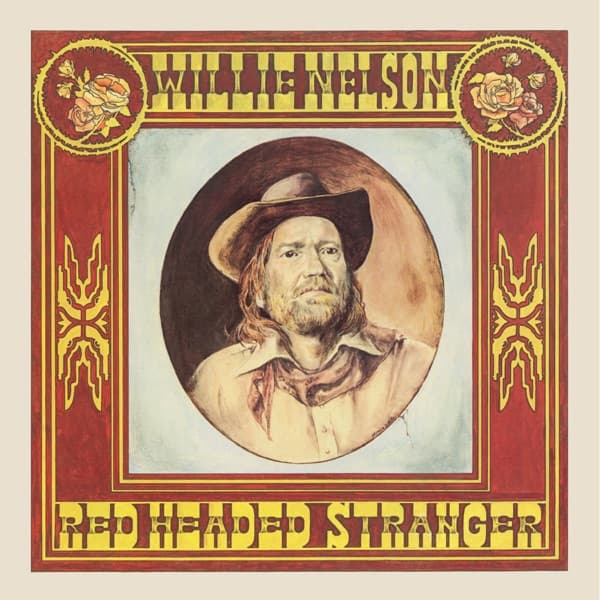
A weathered face stares out from a circle, framed like a saloon portrait or an old tintype: pale eyes, a reddish-brown beard, hair falling loose beneath a battered cowboy hat. The man's expression gives nothing away. A loose neckerchief sits at his throat, his open collar painted in soft, hand-drawn strokes that make the whole thing feel less like a photograph and more like something hung on a frontier wall. This is Willie Nelson, and the portrait is the still center of one of country music's great gambles.
Look at the design and you understand the album before you hear a note. The face floats inside a hand-painted oval of muted blues and browns, ringed by a deep barn-red border the color of dried blood and dust. Across the top, WILLIE NELSON is spelled out in keys that look like ivory piano teeth. Along the bottom, the title Red Headed Stranger runs in bold yellow lettering, slightly uneven, deliberately rough. Two corner medallions hold painted yellow-orange roses, and ornate golden flourishes climb the side panels like ironwork. It reads like signage from another century, fitting for a record built on an old tale.
That tale gave the whole thing its name. The concept came from the 'Tale of the Red Headed Stranger,' a song Nelson used to spin years earlier when he worked as a disc jockey on his radio program in Fort Worth, Texas. He took that ballad of a wandering man and a killing and built an entire story album around it, a landmark murder-ballad concept record where the songs string together into a single grim narrative.
The sound matched the story's starkness. Released in 1975 as his eighteenth studio album, it was cut cheaply at Autumn Sound Studios in Garland, Texas, with arrangements stripped down to little more than guitar, piano, and drums. There were no lush strings, no padding, no gloss. The silences were part of the design.
That sparseness nearly killed it. When Nelson brought the tapes to Columbia Records, executives were baffled, at first mistaking the finished album for a demo. Producer Billy Sherrill heard it and dismissed it outright, asking, 'Did he make this in his living room? It's a piece of shit!... It's not produced.' To ears trained on the polished Nashville sound, an album this bare sounded unfinished.
But Nelson had something most artists never get. He had signed with Columbia precisely because the label handed him total creative control, and he used it. The album went out exactly as he made it, with no further overdubbing, no second-guessing, no studio sheen layered on top. The man who looks out from that painted oval was betting the whole thing on his own instincts.
The bet paid off in a way the doubters never saw coming. Red Headed Stranger went multi-platinum and launched Nelson, by then an American outlaw country singer in full, into genuine superstardom. The title fused to him permanently, becoming a lasting nickname and cementing the outlaw image that the cover's lone, unsmiling gunfighter-stare already promised. Decades later the record sat at #184 on Rolling Stone's 500 Greatest Albums of All Time, and in 2006 it topped CMT's 40 Greatest Albums in Country Music.
So the next time you pass that quiet face in its hand-painted frame, remember it was once mistaken for a throwaway demo and cursed by a producer who heard nothing in it. The roses, the piano-key letters, the steady eyes: all of it belonged to a man who trusted that less could be everything, and turned a song he used to play on the radio into the record that made his legend.