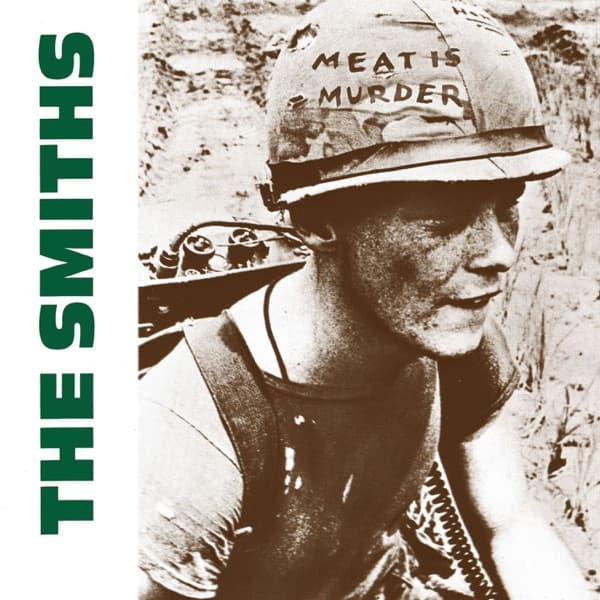

The soldier does not look at you. His gaze drifts off to the right, past the frame, past whatever is happening beyond it, and his mouth is set in an expression that could be exhaustion or contempt or simply the blankness of a man who has stopped feeling anything at all. He is young. His helmet is smeared with camouflage netting and grime, and stencilled across it in block capitals are three words: MEAT IS MURDER. A rifle strap and equipment cross his shoulder. His undershirt is dark with sweat. The whole image is printed in a green-tinted duotone, giving the skin and the jungle behind him the queasy uniformity of an old newspaper photo left too long in the sun.
Those three words on the helmet are a lie, or at least an edit. The man is Marine Corporal Michael Wynn, photographed in Da Nang, South Vietnam, in 1967. When the shutter actually clicked, his helmet read 'Make War Not Love.' The photograph was a publicity still for Emile de Antonio's 1968 anti-war documentary In the Year of the Pig, an Oscar-nominated film about the Vietnam War, and it is credited as such in the album's sleeve notes.
Morrissey designed the sleeve, and it was he who reached into that still and swapped the slogan. 'Make War Not Love' became Meat Is Murder, three words that yoked the horror of the battlefield to the horror of the abattoir in a single visual sleight of hand. The layout was handled by Caryn Gough, and together they multiplied the soldier: on the full sleeve, Wynn's face is repeated four times across the field, ranked like frames of film or like the Andy Warhol silkscreens that turned Marilyn and Elvis and soup cans into hypnotic grids of sameness.
That repetition is the argument. Morrissey told Melody Maker in March 1985 that the image was meant to illustrate his conviction that the only way to end the meat industry, and things like nuclear weapons, was by 'really giving people a taste of their own medicine.' The multiplied soldier is that medicine made visual: violence duplicated until it becomes wallpaper, atrocity flattened into pattern, the individual erased into an assembly line. A single dead-eyed boy is tragedy. Four of him is a system.
On the single-panel image reproduced here, the eye lands first not on the helmet's slogan but on the vertical spine of green letters running up the left edge: THE SMITHS, stacked cleanly against a pale border, the band's name in the same colour that tints the whole photograph. It is the only true typography competing with the stencilled helmet, and the two texts speak to each other across the frame, the band name and the borrowed war cry both rendered in that same sickly green.
The strategy of taking an existing image and bending it to a new message ran through the Smiths' whole visual identity, and here it was pushed to its sharpest political point. This was not a photograph shot for an album; it was found, culled, and rewired. Discogs release notes describe the cover star as 'culled from Emile de Antonio's In The Year Of The Pig' and used by permission. But the man in the picture tells a different story.
Michael Wynn said in 2019 that he was never asked for his permission, and that he 'wasn't real happy' the wording on his helmet had been changed. He did not stumble on his own face in a record shop; his sister did, spotting the album while out shopping, and that was how he first learned that a moment from his war had become the packaging for someone else's argument. Decades on, the young Marine had become a private citizen who never signed up to be a poster.
His image refused to stay in 1985. In its Fall 2019 collection, the New York design house Supreme printed the same soldier onto a denim jacket, carrying Wynn's stare into streetwear and proving that the still had a gravitational pull all its own, long after both the war and the band had passed into history.
What that gravity helped carry was extraordinary. Released on 11 February 1985 through Rough Trade Records, Meat Is Murder became the only Smiths studio album to reach number one on the UK Albums Chart. It debuted with gold-certified shipments of more than 100,000 copies on its first day and knocked Bruce Springsteen's Born in the U.S.A. off the top. There is a strange symmetry in that: one American record giving way to another, Springsteen's blockbuster displaced by an album fronted by the face of an actual American soldier, Wynn, an image enlisted to argue about a war.
Critics have filed the album under indie rock and post-punk, but the cover belongs to a lineage all its own, the appropriated photograph turned into a weapon. Everything that makes the record work is already there in the picture: the coolness of the treatment, the moral seriousness underneath, the willingness to make you uncomfortable and call it kindness. The soldier still stares off the edge of the frame, still sweating in a jungle that stopped existing decades ago, wearing three words he never said, made to speak for a cause he never chose. It is the whole provocation of the Smiths compressed into one stolen, altered, endlessly repeated face.