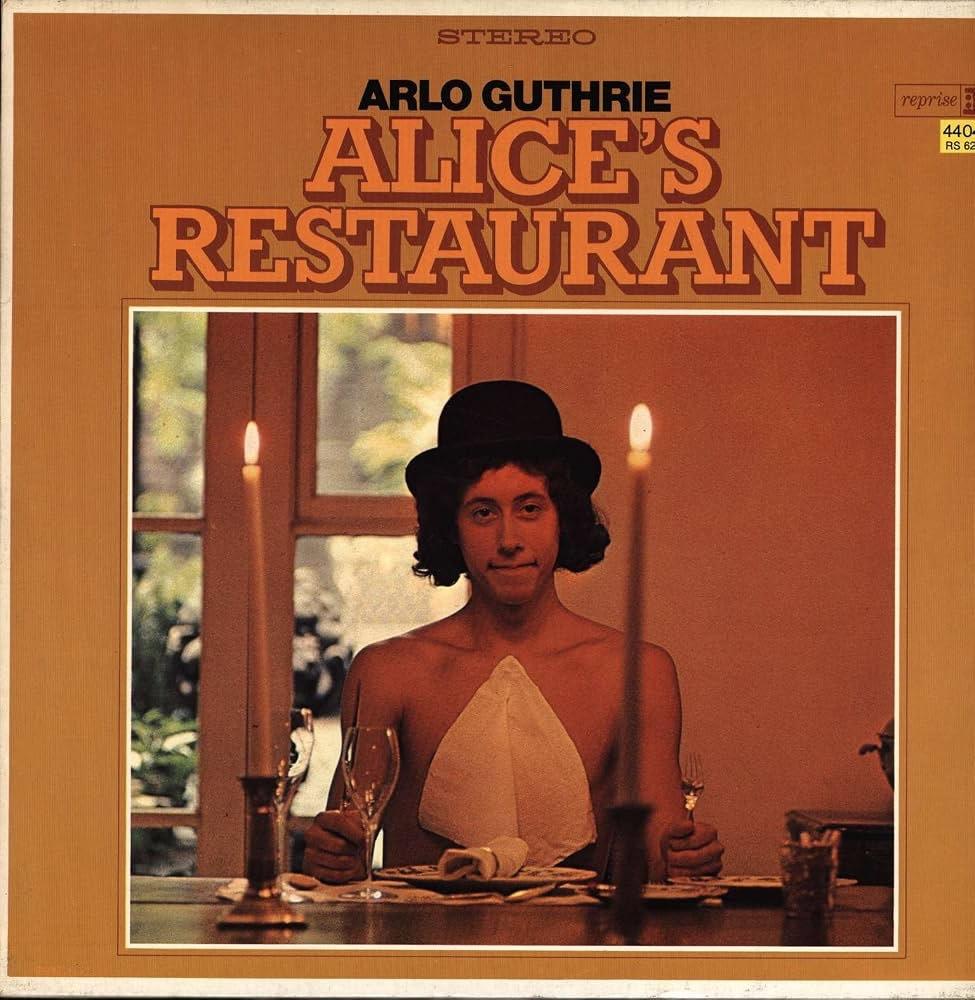

Before Arlo Guthrie tells you about the garbage, the police or the draft, the cover of his debut album invites you to dinner. Guthrie sits at a restaurant table, wearing a hat and a large napkin tucked into his neckline. Glassware and table settings surround him. The scene looks almost ceremonious, which makes it a particularly funny introduction to a record built around a remarkably unceremonious Thanksgiving.
The photographic idea is credited to Richard Chalfin, the front-cover photograph to Sherman Weisburd and the art direction to Ed Thrasher. Diana J. Davies supplied the liner photograph, a separate contribution. Reprise's advertising for the album in the October 28, 1967 issue of Billboard reproduced the dining-table image, establishing that this was the sleeve used in the original release campaign.
The title sounds like an advertisement for a place to eat, and the sleeve plays along. Yet the restaurant itself is hardly the point of the recording. Guthrie's talking-blues narrative grew out of a Thanksgiving visit in 1965 to Alice and Ray Brock in western Massachusetts. A decision to dispose of rubbish improperly led to a littering case, which became the comic hinge of a much larger story about military induction and institutional logic.
What makes the artwork entertaining is its restraint. It does not attempt to illustrate the extraordinary succession of incidents in the song. Instead, it takes the title literally and lets the listener discover how misleading that apparently straightforward invitation can be. The formal table setting becomes an affectionate visual joke, not a diagram of the narrative.
Produced by Fred Hellerman, the record gives the roughly eighteen-minute Alice's Restaurant Massacree an entire LP side. The other side introduces six shorter compositions, including The Motorcycle Song and Highway in the Wind. The sleeve consequently represents both a celebrated spoken narrative and the wider debut of a young songwriter.
Guthrie was the son of Woody Guthrie, but this record established a distinctive voice of his own: conversational, digressive and alert to absurdity. Its title track later inspired Arthur Penn's 1969 film Alice's Restaurant. The original LP and the film soundtrack are separate releases with different artwork, a distinction worth making when identifying the cover.
Decades later the song still returns to American radio around Thanksgiving. In 2017 the Library of Congress selected the recording for the National Recording Registry. The cover retains the charm of a joke delivered with a straight face, inviting the audience into a scene of ordinary hospitality before the story wanders into questions of authority, war and citizenship.