
When H.R. Giger first met Emerson, Lake & Palmer in 1973, the Swiss surrealist artist was still five years away from his Oscar-winning work on Ridley Scott's Alien. The band discovered his haunting biomechanical paintings in a Zurich gallery and knew immediately they'd found the perfect visual translator for their most ambitious album yet.
The concept emerged from the album's themes of technology merging with humanity, a perfect match for Giger's obsession with the intersection of flesh and machine. Keith Emerson, Greg Lake, and Carl Palmer were drawn to the artist's ability to make the mechanical appear alive and the organic seem artificial, creating an unsettling visual paradox that matched their complex musical arrangements.
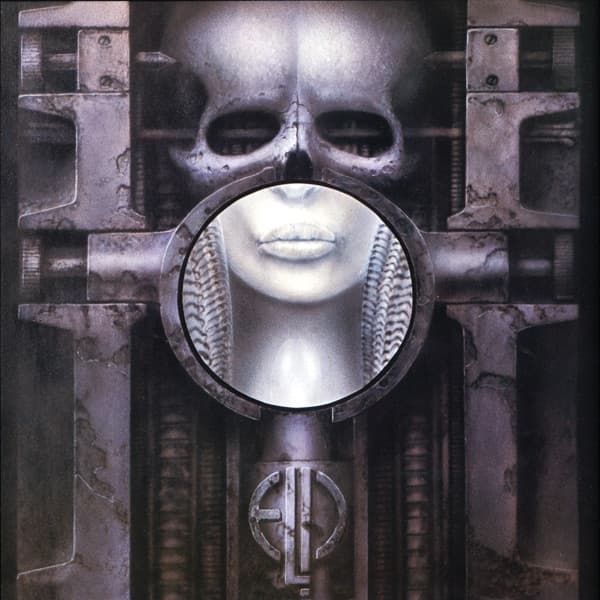
Giger worked for months creating multiple paintings specifically for the project, using his trademark airbrush technique to achieve impossibly smooth gradations between light and shadow. The cover painting features a labyrinthine composition of interwoven forms that seem to pulse with their own internal logic, while the gatefold interior reveals an even more complex biomechanical landscape.
The Swiss artist approached each painting with the precision of an architect, first sketching detailed preliminary drawings before moving to canvas. Giger's use of predominantly black, white, and gray tones with subtle hints of flesh pink created an otherworldly atmosphere that seemed to exist outside normal color relationships. His airbrush technique required countless hours of meticulous layering to achieve the supernatural smoothness that made his forms appear both photographically real and impossibly alien.
Giger was still relatively unknown outside European art circles when ELP's management approached him, making this collaboration a crucial stepping stone in his career. The artist's willingness to create original work specifically for the album, rather than simply licensing existing paintings, demonstrated his commitment to the project. His methodical approach to the commission impressed the band, who gave him complete creative freedom to interpret their musical vision.
Critics and fans were immediately polarized by Giger's nightmarish imagery, with some calling it a masterpiece of fantastic art and others dismissing it as gratuitously disturbing. The cover sparked conversations about the role of album art in an era when rock music was pushing into increasingly experimental territory. Progressive rock fans embraced the artwork's complexity as a visual equivalent to the band's musical sophistication.
The album's success helped establish Giger as the premier artist of biomechanical surrealism, leading directly to his work on Alien and numerous other science fiction projects. Brain Salad Surgery proved that album covers could be serious artistic statements rather than mere marketing tools. The collaboration opened doors for other fine artists to work in commercial music contexts without compromising their vision.
Giger's influence can be seen in countless album covers that followed, particularly in heavy metal and industrial music where his aesthetic of beautiful decay became a visual language. The cover helped legitimize fantasy and science fiction art in gallery contexts, bridging the gap between commercial and fine art. Musicians from Debbie Harry to Korn would later commission Giger for their own projects.
The original paintings for Brain Salad Surgery remain among Giger's most celebrated works, displayed in museums worldwide and inspiring generations of artists working at the intersection of technology and biology. Giger often cited this project as his introduction to the power of music to enhance visual art, claiming that listening to ELP's compositions helped him understand how to create visual rhythms that complemented their musical complexity.