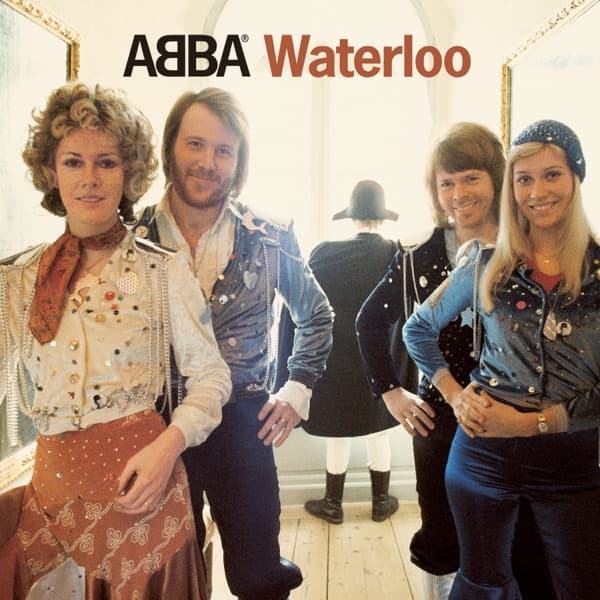
The title runs across the top in two colours: a black ABBA logo sitting beside the word Waterloo set in warm rust-red. It is clean, confident type on a field of pale white light, letting the costumes do the shouting. The design does not clutter the frame. It trusts the photograph, and the photograph is busy enough on its own.
The four in front are styled like a dressing-room raided in a hurry and worn with total conviction. On the left, a woman with tousled honey-blonde curls wears a cream jacket dripping with medallions and studs, a knotted scarf at her throat, a long earth-toned embroidered skirt falling to the floor. Beside her a bearded man in a matching bejewelled jacket leans in, denim below, his shirt open. To the right stands another man, fair-haired and smiling wide, his blue outfit scattered with glinting discs, and next to him a woman in a blue denim cap and a spangled top, hands on her hips in a pose that dares you to look away.
They are packed together, shoulders overlapping, and the mirrors multiply the room behind them so the space feels larger and stranger than it is. The bright, even light flatters everyone and sets the sequins flaring in every direction, the mirrored walls doubling the shine. Nothing here is grim or moody. It is a photograph designed to sell joy.
The whole picture is a visual pun built around the song. Napoleon met his end at Waterloo, and here the beaten general has been shoved to the back of the room while the pop group takes the foreground. The staging turns a battlefield defeat into a stage set, the costumes so heavily jewelled they catch the light everywhere as the real point: this was a group about to be seen by more people at once than they could imagine.
The styling also splits the difference in the music. The rock is in the denim, the open shirts, the loose stance. The pop is in the sparkle, the smiles, the bright flattering light. The outfits carry the colour while the background steps back, and that logic, vivid costumes against pale uncluttered space, is what makes the image read as good-humoured rather than calculated. The grins land first; the turned-back general delivers the punchline; the sparkle does the job it was sewn on to do.