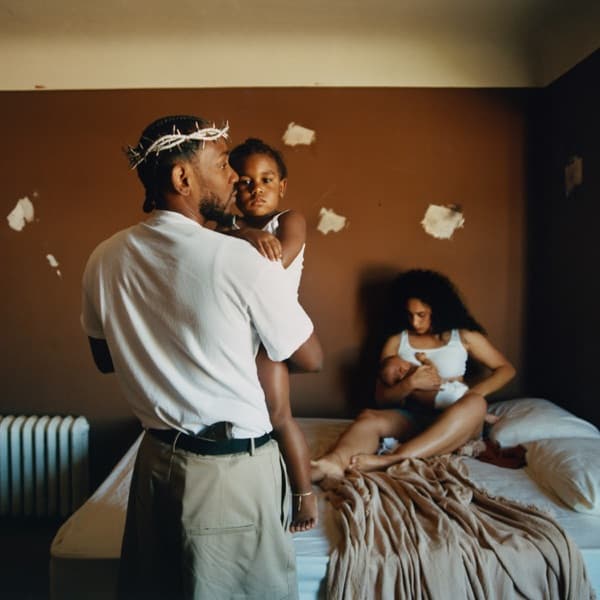
The composition refuses to settle, and that is its argument. Lamar dominates the left of the frame in profile, his white T-shirt the brightest mass in an otherwise warm, dim room. His young daughter anchors the center: her flat, unblinking stare into the lens is the only direct gaze on the cover, so the eye keeps returning to her even as everything around her turns away. Her bare feet dangle, an ankle bracelet catching a little light, small human details against the engineered grandeur of the crown.
Colour does the emotional work. The palette is close and brown, a wall the shade of dried earth, a crumpled tan blanket spilling across an unmade mattress, and the figures rendered in warm, low light. Against that gloom the diamonds of the crown throw the one hard sparkle in the picture, glitter set exactly where you least expect it, in the braided hair of a man who has shown you his back.
The eye then travels rightward, where the tonality softens further. His fiancée sits on the bed in a white tank top and shorts, head bowed, cradling an infant to her chest. She and the newborn drift into soft focus, a second family unit half-dissolved into the warm dark. The focal path is deliberate: sharp father and staring child on the left, blurred mother and baby on the right, so the image reads as a man literally and figuratively turned away, holding one child while another is held by someone else.
The background refuses to comfort. An old white radiator hugs the floor at the left edge, cold and institutional. The brown wall is pocked with patches where paint or plaster has gone missing, pale scars scattered across the warm field. Every one of these choices makes the room read as grim and sparse on purpose, a lived-in, damaged space rather than a set.
Then the detail that reorganises the whole reading: tucked into Lamar's belt is what looks like a gun. It sits low and easy to miss, but once seen it recasts the tenderness. This is a scene of domestic devotion with a weapon in it, protection and threat occupying the same body.
The crown carries the picture's largest idea. A crown of thorns is Christian iconography for suffering borne, and placing it on a father cradling a child folds sacrifice into ordinary domestic life. The genius of its construction is that it looks impossibly heavy while having been made deliberately light, an object of enormous symbolic burden that a person can actually wear and move under, which is close to the whole meaning of the image.
Read as a whole, the cover is a portrait of a man surrounded by the people he is responsible for and still turned inward, faith crowning him, a firearm at his hip, one child watching, one child unseen. It works because it withholds his face. We are given his posture, his family, his symbols, and his weapon, and left to assemble the man from what he is carrying rather than from any expression he offers us.