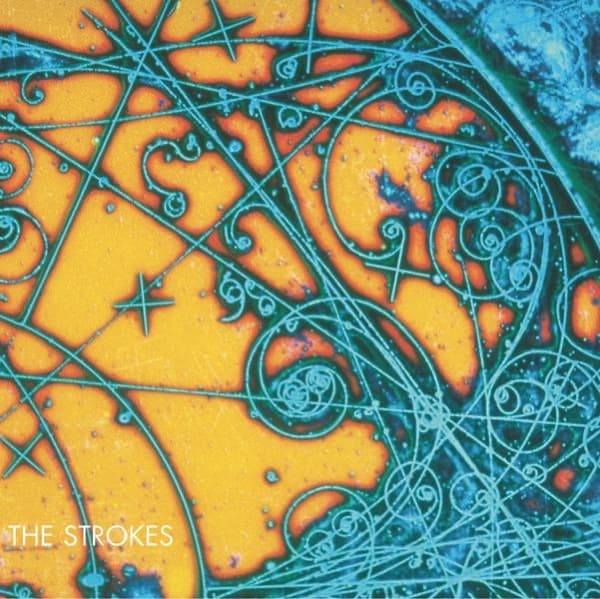

Look closely and you are not staring at art at all. You are staring at physics. The image filling the American cover of Is This It is a photograph of particle collisions, subatomic-particle tracks recorded inside the Big European Bubble Chamber, where charged particles leave curling, spiraling trails as they fly apart.
The eye lands first on the heat: a great burning field of orange and gold, like the surface of a sun or a cross-section of cracked amber. Over it, in electric turquoise, a tangle of lines arcs and spins. Some are dead straight, slicing diagonally edge to edge and crossing into bright four-pointed stars where they intersect. Others coil into tight little whirlpools and question-mark hooks, dozens of them, scattered across the frame like signatures. Along the right edge, deep cobalt and green bleed in, speckled with blue droplets, while the orange dominates the rest. It reads as both microscopic and cosmic at once, vaguely gothic, an abstract pattern with no obvious top or bottom.
Down in the lower left, in plain pale capitals, sit two words: THE STROKES. No fuss, no flourish. The restraint of that small type against the chaos above it is the whole tension of the picture.
This was not the band's first choice of skin. Internationally, Is This It arrived wearing a very different photograph by Colin Lane: a tightly cropped shot of his then-girlfriend's hip and rear, a black leather-gloved hand resting on it. Lane took it before he had even met the band. A stylist had left a pair of black Chanel gloves at his apartment after a fashion shoot for The Independent, and when his girlfriend stepped out of the shower he asked her to put one on. He fired off about ten Polaroids on a Big Shot, the fixed-focus, direct-flash camera Polaroid only made for a few years in the 1970s and a favorite of Andy Warhol. There was, he told NME, "no real inspiration." He was "just trying to take a sexy picture."
That picture caused trouble. UK chain Woolworths was upset enough to consider censoring it, and HMV declined to mount full-scale displays. Lane, meanwhile, walked into Virgin Records in Times Square to find his cover blown up on a giant display, and billboards of it went up around London. The image was later collected in The Greatest Album Covers of All Time.
So why the bubble chamber? The band swapped in this abstract physics photograph for the US release, and their spokesman insisted the change had nothing to do with the UK controversy. There is a wrinkle: their manager recalled Julian Casablancas phoning before the Japan and Europe release to say he had "found something even cooler than the ass picture." But by then the Lane photo was already at the presses, so it stayed on the July and August 2001 editions while the particle tracks took America.
The orange-and-turquoise image came with its own secret history. It had circled the world before The Strokes ever touched it, appearing on Bruce Becvar's 1988 record The Nature of Things, on Prince's 1990 Graffiti Bridge, and on the cover of Freeman Dyson's book The Scientist as Rebel. A found image, passed from physics lab to new-age record to funk icon to a garage-rock debut.
There is a quiet irony in it. The album that, more than any other, got tagged as the garage rock revival, released on RCA internationally and Rough Trade in the UK, fronted itself in two countries with two images that share almost nothing. One is intimate, human, scandalous flesh. The other is cold, scientific, the literal aftermath of things crashing together and flying apart. Lane shot every band portrait in the booklet too. But the face the United States saw was no face at all, just light and motion frozen mid-collision, asking, in pale letters, is this it.