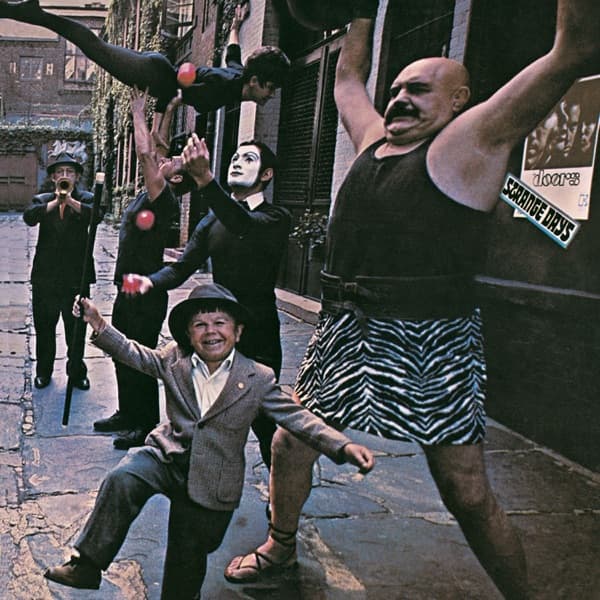
Search the cover of Strange Days for the four faces of the band and you will not find them, not at first. A bald strongman in a black tank top and zebra-print shorts strains at the right edge, arms raised. A tiny man in a tweed jacket and fedora grins in a deep lunge at center, one sandaled foot extended. A white-faced mime, a juggler tossing red balls, acrobats balanced midair, and a trumpet player lifting his horn in the far background fill out the rest. The only trace of The Doors is a small poster taped to the brick wall on the right, the band's name and the words SZRANGE DAYS printed beside four shadowy heads.
That absence was the whole point. Jim Morrison refused to appear on the cover, so photographer Joel Brodsky abandoned the idea of a band photo altogether and built a scene instead. He drew on Federico Fellini's 1954 circus film La Strada, populating a New York alley with carnival performers as a stand-in for the music's off-kilter spirit.
The location was Sniffen Court, a small residential mews off East 36th Street between Lexington and Third Avenue in Manhattan. The ivy-draped brick, the worn flagstone underfoot, the wrought-iron lamp and shuttered doors all belong to that real, narrow alley. The afternoon light is warm and low, catching the strongman's shoulders and the child performer's grin while the depth of the lane falls away into cool shadow.
Most of the cast were not performers at all. Only the acrobats, the figures hoisted impossibly overhead, were the real thing. The muscleman flexing at the right was the doorman at the Friars Club. The juggler in black, mid-toss with his red balls, was Brodsky's own assistant. And the trumpet player in the distance, in a dark suit and hat, was a cab driver the team pulled off the street and paid five dollars; he later phoned Brodsky asking how to pursue a modeling career.
The day itself turned strange to match the title. Brodsky later recalled the cast piling into a limousine, the dwarves perched on the strongman's lap smoking cigars. The image that survives keeps that ad-hoc, slightly unreal energy: figures frozen mid-gesture, the eye bouncing from the grinning little man at the front to the looming strongman to the masked mime, never settling, exactly the disorientation the music chases.
The concept came from William S. Harvey, Elektra's full-time art director, who conceived the cover and handled the art direction. Harvey was the hand behind many of the label's sleeves, and he shaped this one around the band's refusal rather than fighting it. Brodsky shot five Doors covers in all and earned a Grammy nomination for the group's 1967 debut.
Released on September 25, 1967 by Elektra Records, Strange Days climbed to number three on the Billboard 200 and eventually went platinum, though it lived in the long shadow of the band's debut. Its cover endures partly because it broke the rule it was meant to follow: the band's frontman hid himself, and a hired doorman, a cab driver and a juggling assistant became the public face of one of the year's biggest records.