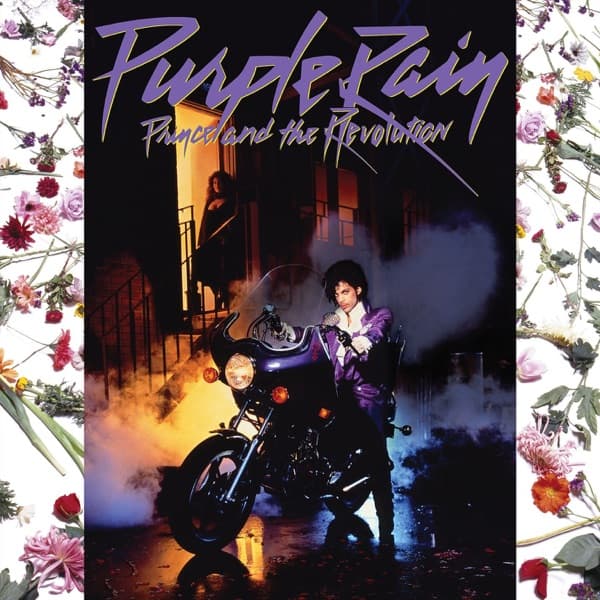
Purple Rain is not a placeless studio portrait. Its front image belongs to the same visual world as the film: Prince on his customized purple motorcycle, smoke and theatrical light around him, with Apollonia Kotero visible in the doorway behind. The scene was staged on Warner Bros.' backlot in Burbank, California, using an exterior set designed to read as an urban street and apartment environment.
The package credits are more specific than BTC's old single-name photography line. Prince is credited with LP art direction, Laura LiPuma with design, and the front-cover photograph with Ed Thrasher & Associates / Ron Slenzak. That division matters because the sleeve was not simply a photograph placed on cardboard; it was a film image reworked into a record package.
Laura LiPuma Nash later explained that this was her first full album project with Prince and that the movie poster created an immediate format problem. The poster was vertical, while the LP cover had to be square. Cropping away the poster image would have sacrificed too much, so LiPuma had flowers created as side borders. Those floral panels are therefore not arbitrary decoration or symbolic filler: they are a documented design solution to the geometry of adapting a poster into an album sleeve.
LiPuma also recalled examining the poster image with a loupe and noticing a small combined male/female glyph painted on the motorcycle's gas tank. She redrew her own interpretation of it for a sticker used with the first album package. She did not claim to have invented the original symbol, but her package work helped carry that detail into Prince's broader visual language.
The cover's power comes from the collision of staged cinema and graphic packaging. Prince is unmistakably the focal figure, but he is not alone and he is not floating in an abstract void. The doorway, building facade, wet-looking street set, motorcycle, smoke, costume, floral border and Apollonia all contribute to a constructed world that connects the record directly to the film.