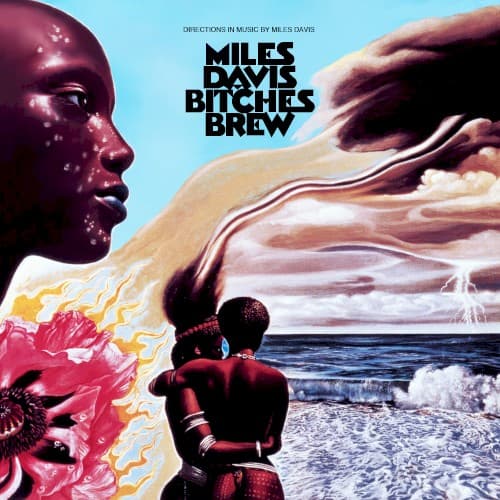

Mati Klarwein was a German-born painter who had studied with Fernand Leger in Paris and spent years traveling through India, Morocco, and Bali before settling in New York, where his psychedelic-realist canvases caught the attention of Miles Davis. For the cover of Bitches Brew, Davis's 1970 double album that effectively invented jazz-rock fusion, Klarwein produced a painting that matched the music's hallucinatory intensity: a panoramic landscape of impossible colors and morphing figures that fused African, Indian, and psychedelic visual traditions into something entirely new.
The painting spans both panels of the gatefold sleeve. On the front, two massive faces confront the viewer in profile, one appearing to emerge from ocean waves on the left, the other from volcanic earth on the right. Between and around them, the landscape churns with organic forms that resist easy identification: flower-like structures that might be sexual organs, wave patterns that might be hair or smoke, geological formations that might be bodies. The entire surface seethes with a biological energy that mirrors the album's restless, ever-mutating musical textures.
Klarwein's technique combined the precise draftsmanship of academic painting with the saturated color and spatial distortion of psychedelia. Every square inch of the canvas is packed with detail rendered in fine brushwork, creating a density that rewards prolonged examination but overwhelms at first glance. The profiles of the two central faces are painted with portrait-quality realism, their features clearly African, but the surrounding environment dissolves into abstraction, as though the figures are generating the landscape through the force of their presence.
The color palette is volcanic. Deep reds, electric blues, ochre yellows, and vivid greens collide without the mediation of neutral tones or negative space, creating a chromatic saturation that parallels the album's dense, layered sound. The warm tones dominate, giving the image a thermal quality, as though the paint itself radiates heat. Cool blues appear in the ocean elements at left and in scattered highlights, providing just enough contrast to prevent the warm palette from becoming oppressive. The overall effect is of a landscape at the moment of creation, still molten, still forming.
The back cover continues the painting in a reversed color scheme, with cooler tones dominant, suggesting a transition from day to night, from fire to water, from the aggressive outward energy of the front to a more introspective, submerged state. This structural pairing mirrors the album's two-disc format and its own oscillation between explosive group improvisation and quieter, more spacious passages. Klarwein conceived the painting as a single continuous work that the gatefold seam divides but does not interrupt.
Typography is minimal and deliberately secondary. Miles Davis's name and the album title appear in a compact, organic font that sits within the painting rather than floating above it, as though the letters grew naturally from the visual environment. The text does not interrupt the image but participates in it, occupying the same spatial plane as the painted elements. This integration of word and image reflects the album's own refusal to separate compositional intention from improvisational spontaneity.
Davis's decision to commission Klarwein rather than use a photograph was itself a statement. Jazz album covers in 1970 typically featured either Blue Note-style portrait photography or abstract geometric designs. By choosing a painting of hallucinatory intensity, Davis signaled that Bitches Brew belonged to no existing tradition, that it was creating its own visual and sonic language simultaneously. The cover told potential listeners exactly what to expect: an immersive, disorienting experience that demanded surrender rather than analysis.
Klarwein went on to paint several more covers for Davis, including Live-Evil and On the Corner, but Bitches Brew remains his most celebrated work in the medium. The painting's influence extends beyond album art into the broader tradition of psychedelic and Afrofuturist visual culture, where its fusion of African imagery, biological abstraction, and hallucinatory color anticipated the aesthetic that Parliament-Funkadelic, Sun Ra, and later Janelle Monae would develop through different means. It remains one of the rare album covers where the artwork's ambition genuinely equals the music's.