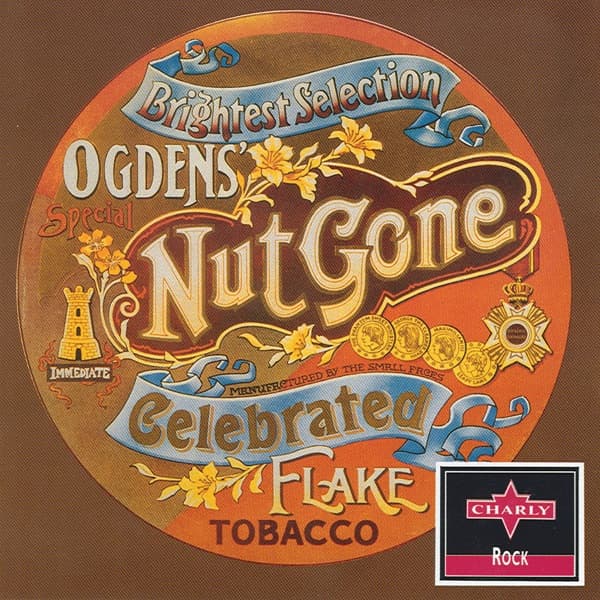

Look closely and you are holding a tobacco tin, not a record. The whole front is a perfect circle glowing in oranges and burnt golds, ringed by a darker amber band, the kind of lid you would prise open with a thumbnail. Ribboned banners loop across it in pale blue, arched along the top reading 'Brightest Selection' and curving across the bottom as 'Celebrated.' Yellow lilies and daffodils sprout between the lettering, a little castle tower sits on the left, a cluster of coins and a crowned medal hang on the right. It is Edwardian shop-counter decoration, faithfully copied, with one cheeky lie at its center.
That lie is the title. Ogdens' Nut Gone Flake parodies a genuine brand, Ogdens' Nut-brown Flake, made by the Liverpool firm Ogden. The story behind the swap is the joke of the whole sleeve: singer Steve Marriott suggested changing 'Brown' to 'Gone.' As Ian McLagan put it, the idea was that it would look like their own brand of hash. 'Gone, meaning being out of your head; your nut's gone!' So the most respectable-looking object in your collection is quietly advertising the band's hashish intake.
The text keeps up the disguise everywhere you look. Across the middle, snaking around the big curved 'Nut Gone' lettering, runs the line 'Manufactured by the Small Faces,' as though the band were a tobacco concern. The word 'Special' tilts in red script beside the tower, the company name 'Immediate' sits in tiny serif caps beneath it, and at the very bottom, in plain block capitals, the single word 'TOBACCO' anchors the gag. Only the small black-and-red Charly Rock logo boxed in the lower corner breaks the spell, marking this as a later issue.
The object began as a loan. Ogden's tobacco firm lent Immediate Records an actual Victorian tin design, and someone copied and adjusted it by hand into the round shape you see. Designer Mick Swan is the man behind both the round metal and the cardboard versions of the sleeve. The press-grabbing concept of making the sleeve round in the first place came from Andrew Loog Oldham, who knew a circular record cover would attract publicity simply by refusing to sit flat on a shelf.
The gatefold was die-cut into that tobacco-tin circle so it folded out, and the original carried 'U.K. Patent Application No. 21639/68' printed on the rear, treating a pop album like a piece of patented packaging. Inside, art-school friends Nick Tweddell and Pete Brown painted psychedelic collages complete with butterflies. The interior drawing is credited to 'P. Brown,' and one inner image shows a pack of rolling papers stamped with the word 'Sus,' slang for suspect activity, another nudge and a wink for anyone paying attention. The sleeve also folded out around Gered Mankowitz's photos of the band.
Ambition outran the budget. The original round metal-tin packaging proved too costly to produce and had to be replaced with a cardboard version, which is the form most people held. The reissue later faithfully recreated that 1968 fold-out round card sleeve, with award-winning artwork and design credited to Nick Tweddell, Mick Swan and Pete Brown.
As the band's fourth studio album and a 1968 concept record, Ogdens' Nut Gone Flake wrapped its music in this elaborate masquerade. The eye lands first on the warm circle and the swirling fairground lettering, reads it as harmless old-world charm, then slowly registers that 'Nut Gone' is a punchline. That is the genius of the design: it hides a stoned in-joke inside the most upright object imaginable, a chemist's tin, and dares you to notice.