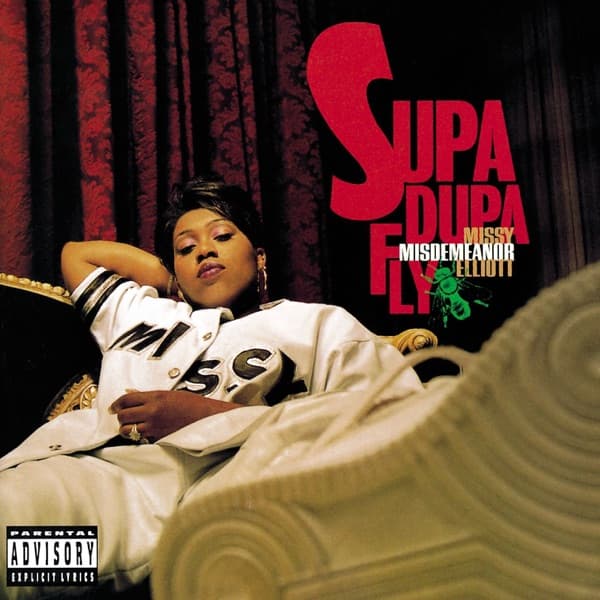
Hype Williams photographed and directed the visual identity for Missy Elliott's 1997 solo debut, creating the single image that would define her public persona: Elliott standing in a massively inflated black trash bag suit, shot from below with a fisheye lens that distorts her body into a spherical form that fills the entire frame. The suit, designed by June Ambrose, was made from actual garbage bags inflated with air, creating a shape that was deliberately outrageous, deliberately unflattering by conventional standards, and deliberately impossible to ignore.
Williams's use of the fisheye lens was not merely a stylistic choice but a conceptual one. The extreme barrel distortion of the lens bends Elliott's inflated suit into a near-perfect sphere that dominates the composition, making her body a monumental presence that occupies more visual real estate than any figure in hip-hop cover art before or since. The low camera angle, shooting upward from below Elliott's eye line, adds to the sense of scale and power, placing the viewer in a subordinate position looking up at an imposing figure who is simultaneously absurd and majestic.
The background is a flat, dark field that provides no contextual information and forces all attention onto Elliott's suited figure. Williams's lighting is dramatic and directional, creating highlights on the shiny surface of the trash bag material that give it a sculptural, almost metallic quality. The black of the suit absorbs most of the light, while these highlights trace the inflated contours of the form, defining its shape through gleam rather than color. The result is an image that feels three-dimensional and tactile, the suit's surfaces reading as both fabric and skin.
The fisheye distortion creates a circular composition within the rectangular frame, with Elliott's body curving at the edges in a way that suggests she is too large to be contained by the camera's field of view. Her face, positioned near the center of the lens where distortion is minimal, remains relatively undistorted and clearly visible: the heavy-lidded eyes, the slightly parted lips, the expression of supreme confidence that communicates control over every element of the image. The face is the still center around which the inflated form orbits.
The color palette is almost entirely monochromatic: the deep black of the trash bag suit, the slightly lighter black of the background, and the white-to-grey highlights where studio lighting catches the bag's surface. Elliott's skin provides the only warmth in the image, her brown complexion glowing against the surrounding darkness. This restricted palette concentrates visual attention on form and texture rather than color, making the suit's inflated contours the image's primary subject.
The conceptual brilliance of the trash bag suit lies in its simultaneous rejection and reclamation of the gaze directed at women in hip-hop. In 1997, female rappers and R&B singers were overwhelmingly presented as objects of male desire, their covers emphasizing thinness, curves, and sexual availability. Elliott's inflated suit obliterates these conventions: the body beneath is completely concealed, its shape rendered literally unreadable, replaced by a form that is proudly, aggressively non-normative. The suit does not hide Elliott's body in shame but transforms it into something larger, stranger, and more powerful.
The typography positions Elliott's name and the album title in a font that complements the cover's bold, confrontational energy. The text is rendered with sufficient weight and scale to be legible against the dark background, but the image clearly dominates the design. The overall layout prioritizes visual impact over informational clarity, treating the cover as a statement piece rather than a labeled product.
Supa Dupa Fly's cover permanently altered the visual possibilities for women in hip-hop. The trash bag suit became an icon of body positivity, creative fearlessness, and the refusal to perform conventional femininity for the male gaze. Elliott's collaboration with Williams established a director-artist visual partnership as influential as any in hip-hop history, and the fisheye-lens aesthetic they pioneered became one of the defining visual styles of late-1990s music culture. The cover proved that the most memorable image is not always the most flattering, and that true style is the courage to define beauty on your own terms.