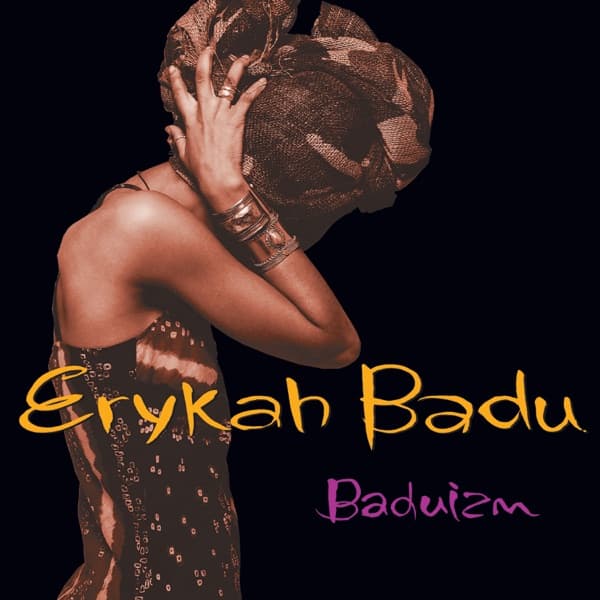

The cover of Erykah Badu's 1997 debut presents the singer in a portrait that established her visual identity as one of the most distinctive in popular music: a tall, elaborately wrapped head covering that rises above her face like a tower or a crown, her features composed in an expression of regal serenity that communicates spiritual depth and artistic seriousness. The photograph, warm-toned and softly lit, introduces the Afrocentric, neo-soul visual aesthetic that Badu would continue to develop throughout her career.
The head wrap is the portrait's architectural centerpiece, a towering structure of fabric that adds height and visual drama to Badu's already striking appearance. The wrap references West African traditions of head covering as both aesthetic expression and spiritual practice, but Badu's interpretation is distinctly personal, neither historical reproduction nor fashion trend but something entirely her own. The fabric is arranged with the care and precision of sculpture, its folds and layers creating a complex geometry of shadow and highlight that rewards prolonged examination.
The lighting is warm and directional, creating a Rembrandt-like quality that models Badu's features with rich shadows and luminous highlights. The key light appears to come from the upper left, casting a soft shadow that defines the bridge of her nose, the plane of her cheek, and the structure of the head wrap. The warm color temperature gives Badu's skin a golden glow that is both flattering and symbolically charged, associating her with the warmth of earth, sun, and the African landscapes that her music evokes.
The composition is a classic three-quarter portrait, showing Badu from the shoulders up with her body angled slightly away from the camera and her face turned back toward the lens. This traditional portrait format places Badu within a lineage of painted portraiture that stretches from Renaissance masters through Dutch Golden Age painting to contemporary fine art photography. The choice to use this formal, historically weighted composition signals that Badu sees herself not as a pop star to be consumed but as an artist to be contemplated.
The color palette is built from the warm, earthy tones that would become Badu's chromatic signature: deep browns, warm ambers, and the rich, saturated hues of her head wrap, which may include accents of gold, burnt orange, or deep red depending on the pressing. The background is a warm, dark tone that recedes behind the figure without competing for attention. The absence of cool tones creates a visual environment of pure warmth, an embrace of heat and richness that mirrors the album's musical temperature.
Badu's expression in the portrait communicates a self-possession that was revolutionary in the context of 1990s R&B, where female artists were typically presented in poses that emphasized sexual availability or romantic vulnerability. Her gaze is level, calm, and appraising, meeting the viewer with the quiet confidence of someone who knows her own worth and does not need external confirmation. The absence of a smile is significant: it refuses the expectation that female artists perform pleasure or accessibility for the camera.
The typography for the album title, Baduizm, uses a custom font that combines elements of Afrocentric design with contemporary clean lines, establishing a visual brand that, like the music, synthesizes the traditional with the modern. The text is integrated into the lower portion of the cover with a spacing and weight that complement rather than compete with the portrait.
Baduizm's cover established Erykah Badu as a visual icon whose influence on Black women's self-presentation in popular music has been as significant as her musical influence. The tall head wrap, the regal bearing, the warm earth tones, and the refusal of conventional beauty standards created a visual template that Lauryn Hill, India.Arie, Janelle Monae, and many others have drawn from in their own ways. The cover proved that a woman artist could command the visual space of an album with presence and dignity alone, without spectacle or provocation.