The illustration rewards close looking in a way few album covers do, because Srinivasan builds it as a densely layered scene rather than a single focal image. Her style leans on intricate line work, flat washes of color and a folk-art sensibility that sits somewhere between children's book illustration and broadsheet woodcut. It carries the weight of the album's ambition without announcing it: the drawing looks approachable, almost naive, yet it is packed with information.
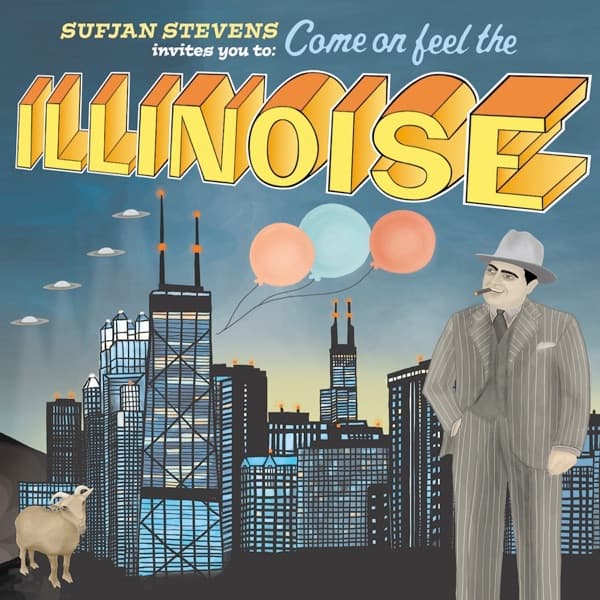
The layout is a horizon scene. A blocky, deco-lettered title band spans the top like a fairground marquee, its yellow slab letters reading as an actual spoken invitation to the viewer. Below it the eye drops into a gradient sky, warm orange at the horizon cooling to blue-grey above, against which the Chicago skyline stands in near-silhouette, the Sears Tower among the recognizable landmarks. Small saucers scatter across the upper left, and three balloons on strings float up the center, giving the composition a light vertical lift that offsets the heavy horizontal of the buildings.
Srinivasan populates this stage with Illinois iconography of wildly different registers. Abraham and Mary Todd Lincoln, Al Capone rendered in a pinstripe suit with a cigar, the Native leader Black Hawk, a lone animal grazing in the foreground, UFOs, and originally Superman all appear together. The key compositional decision is that every figure and landmark is given roughly equal visual standing regardless of historical scale. A murderer, a president, a myth and a UFO share the frame without hierarchy.
That flattening is the meaning. The cover does not frame Illinois as a place so much as a mythology, a continuous field where the documented and the invented carry the same weight. It mirrors what Stevens was doing musically, treating the mundane and the mythic as continuous, folding real history and tall tale into one songbook. The cheerful, storybook surface is doing quietly ambitious work: it insists that a state is the sum of everything people believe about it.
The cast also functions as a visual index to the songs, its figures reflecting historically literate lyrics that run from Black Hawk and Lincoln to Al Capone, so the sleeve behaves like a table of contents disguised as a postcard. The whole image works because its guileless folk-art warmth makes an unusually crowded, allusive picture feel welcoming rather than dense, pulling the eye from face to landmark to saucer and back to the title's grinning pun.