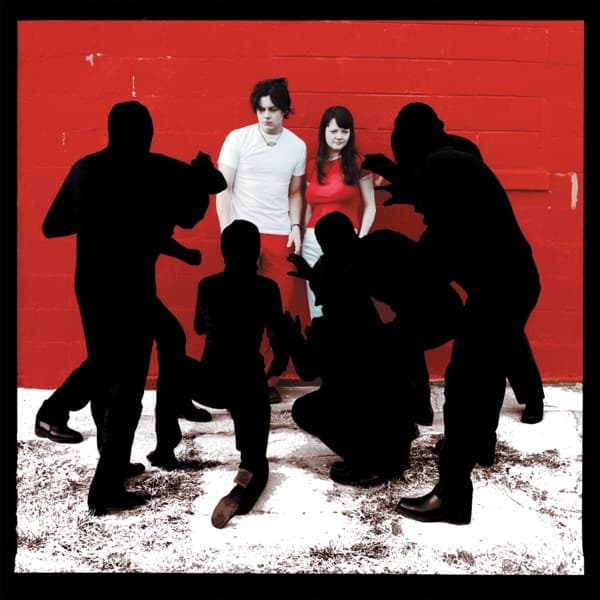


The cover of The White Stripes' 2001 breakthrough album continues the band's rigorous self-imposed color restriction: every visual element exists in red, white, or black, with no other colors permitted. The image presents a collage of photographs showing Jack and Meg White in various poses and settings, arranged in a grid-like pattern against a white background, each image treated with high contrast to reduce the photographic information to the three permitted tones. The result is a visual system as strict and generative as the band's musical rules: two members, no bass player, three colors, limitless possibilities.
The photographs in the collage range from live performance shots to staged portraits, each processed to the same high-contrast standard that eliminates middle tones and pushes every pixel toward pure red, pure white, or pure black. This processing gives the images a graphic, almost screenprinted quality that references pop art, Russian Constructivist design, and the DIY aesthetic of punk fanzines simultaneously. The variety of the source images, some intimate, some energetic, some posed, some candid, creates a visual narrative of the band's world while the uniform color treatment binds them into a single, coherent statement.
The composition arranges the photographs in a loose grid that fills the cover surface with the horror vacui density of a punk collage or a bedroom wall covered in clippings. The images overlap slightly at their edges, and the spacing between them is irregular, creating a visual rhythm that is structured but not rigid. This compositional approach mirrors the band's musical method, where blues, punk, and country forms provide structure while performance energy provides spontaneity.
The red that dominates the color palette is a specific shade: a warm, slightly orange-tinted red that carries associations of passion, danger, and physical intensity. Against the white background and the black of Jack White's hair and clothing, this red vibrates with a visual energy that makes the cover feel kinetic even in stillness. The three-color restriction, which Jack White has described as both an artistic discipline and a philosophical statement about the creative power of limitation, gives the band's visual identity an instant recognizability that more elaborate designs could not achieve.
Jack White's visual direction for the band drew on a wide range of influences: the color theory of De Stijl, the graphic boldness of Soviet political posters, the simplicity of children's toys, and the visual intensity of candy packaging. These references converge on the White Blood Cells cover into an aesthetic that feels simultaneously sophisticated and naive, art-school smart and garage-band raw. The tension between these registers is the band's central creative principle, applied to visuals as rigorously as to music.
The typography for the band name uses a custom font that maintains the three-color restriction, rendering the letters in red and white with black accents that give the text a three-dimensional quality. The font is bold and slightly distorted, with an energy that suggests hand-lettering even though it is typeset, maintaining the handmade quality that permeates the band's visual and musical aesthetic.
Meg White's presence in the collage is as essential as her drumming: her pale face and dark hair provide visual contrast to Jack's more expressive mugging, and her stillness within the images creates a counterpoint to his energy, just as her steady drumming anchors his guitar histrionics. The visual relationship between the two figures mirrors their musical relationship: one is the constant, the other the variable, and the tension between them generates the art.
White Blood Cells' cover art helped establish the visual identity of the garage rock revival of the early 2000s, where color restriction, lo-fi processing, and DIY collage techniques became markers of authenticity and artistic seriousness. The three-color system that the White Stripes maintained throughout their career proved that limitation could be liberation, that working within strict constraints could produce a visual identity more distinctive and memorable than any amount of creative freedom.