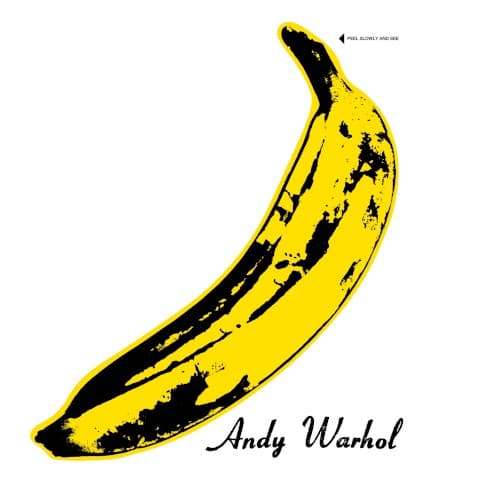
The design works by subtraction. Warhol strips the sleeve to a single object on an empty white ground, and that emptiness is the composition's real subject. With nothing to compete against, the banana becomes enormous, filling the square from corner to corner, its diagonal sweep dictating how the eye travels: stem at the upper left, the long curved body pulling down and to the right in one unbroken gesture.
The palette is almost defiantly limited. Bright, flat cartoon yellow reads as pure signage, the color of a warning or an advertisement, while the black shadows do not model the fruit so much as sit on top of it, splotching the skin like ink that has slipped its register. That deliberate roughness is the Pop-art tell: the fruit is not observed from life but reproduced, a printed thing about printing, mechanical reproduction wearing its seams on the outside.
Typography is kept to a whisper. The only words are Warhol's cursive signature along the bottom edge, which frames the whole image as a signed artwork rather than a band's advertisement, and the small block-letter instruction in the corner. That instruction changes everything, converting a static picture into a set of directions. The arrow aimed at the stem gives the focal path a destination and turns looking into doing.
The interactive element carries the meaning. Pulling the yellow skin back revealed a flesh-colored banana underneath, and the reveal was the point. Warhol biographer Blake Gopnik later compared the gesture to peeling back a foreskin, arguing the jacket tied the band to the queer culture of Warhol's Factory. Whether or not a viewer reads it that way, the erotic charge is unmistakable, so much so that the banana made it into an erotic art show, a fact Lou Reed seemed to relish recounting: "The banana actually made it into an erotic art show."
What makes the image hold together is the tension between its innocence and its innuendo. On the surface it is a friendly, almost childish drawing of a piece of fruit, three colors on white, harmless as a supermarket label. But the instruction to peel, the pink flesh beneath, and the single artist's signature reframe that harmlessness as bait. The cover offers you a joke and a temptation at once, and it will not tell you which. That refusal, the dare left hanging, is why so spare an image keeps rewarding a second look.