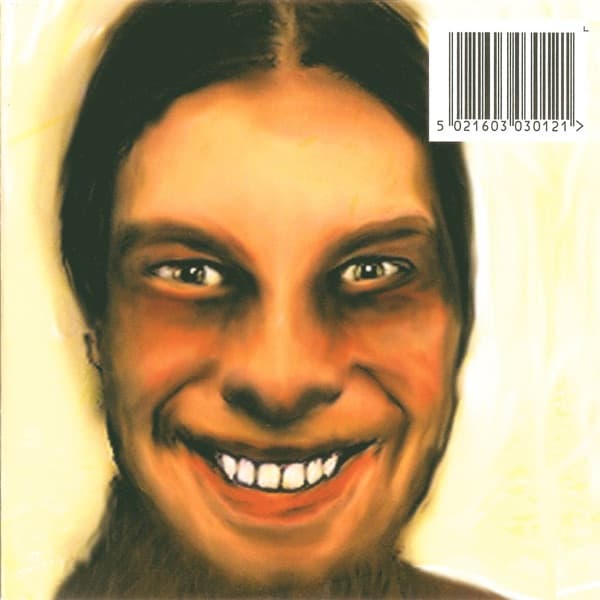


The cover of Aphex Twin's 1995 album presents a painted portrait of Richard D. James, the artist behind the Aphex Twin moniker, rendered in a style that transforms his face into something between a photorealistic likeness and a hallucinatory distortion. The painting, created by Dave McKean, the illustrator and designer best known for his work on Neil Gaiman's Sandman comics, captures James's distinctive grin, a wide, unsettling smile that had already become the visual signature of his music, in a medium that amplifies its uncanny quality.
McKean's technique combines precise anatomical observation with painterly distortion, creating a portrait that is simultaneously accurate and wrong. The proportions of James's face are slightly altered, the grin widened beyond natural limits, the eyes given a brightness that suggests either ecstasy or madness. The brushwork is visible throughout, with areas of thick impasto where the paint builds up three-dimensionally contrasting with smoother passages where the surface approaches photographic precision. This oscillation between control and chaos mirrors the Aphex Twin's musical method of combining meticulous programming with deliberately abrasive textures.
The background is a field of dark, indeterminate color that provides no context or environment, isolating the face as the sole subject of the image. This pure portraiture, face against void, has a confrontational quality that is characteristic of both McKean's illustration work and James's public persona: the viewer cannot look away from the face, cannot find refuge in background detail or compositional complexity, and must engage with the unsettling combination of friendliness and menace that the grin communicates.
The color palette is built on flesh tones pushed toward the extremes of warm and cool. The highlights on James's skin are almost white, bleached by the light source to a pallor that suggests illness or nocturnal living, while the shadows are warm browns and deep reds that give the face a feverish quality. The background is a cool, dark blue-grey that makes the warm skin tones push forward aggressively, as though the face is emerging from darkness toward the viewer. This warm-cool contrast creates a visual tension that the grin converts into psychological unease.
The painting's surface quality is an essential part of its meaning. Where a photograph would present James's face as a documentary record of physical reality, McKean's painted interpretation introduces the artist's hand as a mediating presence, reminding the viewer that this is not the person but someone's rendering of the person. The visible brushstrokes, the slight distortions, the areas where paint has been built up or scraped away, all contribute to a sense that the portrait is alive, still in the process of becoming, not yet fixed into a final form.
The album title, ...I Care Because You Do, is rendered in a clean sans-serif font positioned below the portrait, its ellipsis suggesting an incomplete thought or a statement whose context has been removed. The typography is minimal and clinical, contrasting with the organic, handmade quality of the painting and creating a juxtaposition between emotional expression and mechanical reproduction that runs throughout James's work.
The back cover and inner artwork extend McKean's vision with additional painted and collaged elements that maintain the album's visual tone of cerebral unease. The packaging as a whole creates a world where the boundary between human and artificial, between portrait and distortion, between recognition and alienation, is deliberately blurred.
The cover of ...I Care Because You Do established a visual precedent for electronic music that used fine art rather than graphic design to communicate artistic seriousness. McKean's painted portrait signaled that the Aphex Twin was not merely a producer of dance tracks but an artist whose work demanded the same kind of visual interpretation as a musician in any other genre. The unsettling grin on the cover became the defining image of the Aphex Twin's public persona, reproduced and parodied across the electronic music community and beyond.